Is my baby having a growth spurt? How to see it in your feed and sleep log
Published 3 November 2026 · Đào Văn Thương · 4 min read
“Is my baby having a growth spurt?” is usually typed at an odd hour, after a few days of a baby who wants to feed far more often than last week. Parenting sites give a list of ages and signs. What they cannot tell you is whether it is your baby, this week. Only your own numbers can, and they are easy to collect.
This guide explains what public sources say, why the ages are only rough, and how to compare a few days of feeds and sleep with the week before, on paper or in Baton: Baby Tracker. It is general information, not medical advice. If you are worried about your baby's feeding or growth, ask your midwife, health visitor or pediatrician.
This guide is general information, not medical advice. Follow what your doctor, midwife or health visitor told you, and call emergency services in an emergency.
What do public sources say about growth spurts?
KidsHealth, from the children's health organisation Nemours, says a breastfed baby's appetite often rises during growth spurts, typically around 6 weeks and around 3 months, and that you may find your baby wants to feed more often. It advises following your baby's hunger cues rather than the clock, because the extra feeding is also how your body learns to make more milk.
Cleveland Clinic notes that bunched feeds also show up during growth spurts and developmental leaps, and that very frequent feeding around the clock is normal in the first days of life. Our guide on cluster feeding covers the evening version.
Many parenting sites quote more ages, such as 2 to 3 weeks or 6 months. Treat all of them as rough. Babies do not follow a calendar, and no public health body gives a date on which your baby will have one.
What can it look like?
The signs parents describe most are a few days of more frequent feeds, a baby who seems hungrier or fussier than usual, and sleep that is shorter or more broken. Most descriptions say it lasts a few days and then settles.
None of these proves a growth spurt. A cold, teething, a sleep regression, a warm room, a busy day out or a change in how much milk the baby gets per feed can look the same. This is why a number from your own log is more useful than a symptom list.
What to write down
You do not need a new system. If you already log feeds, you have the data. If not, start with:
- The time of every feed, and which side or how many ml if you know it.
- Sleep: when it started and ended, including night wakings.
- Wet and dirty diapers, in a line each.
- A note when something else changed: a cold, a vaccination, a long trip, a new food.
A normal week gives you a baseline. A few days that sit well above it are worth a note.
How do I see it in Baton?
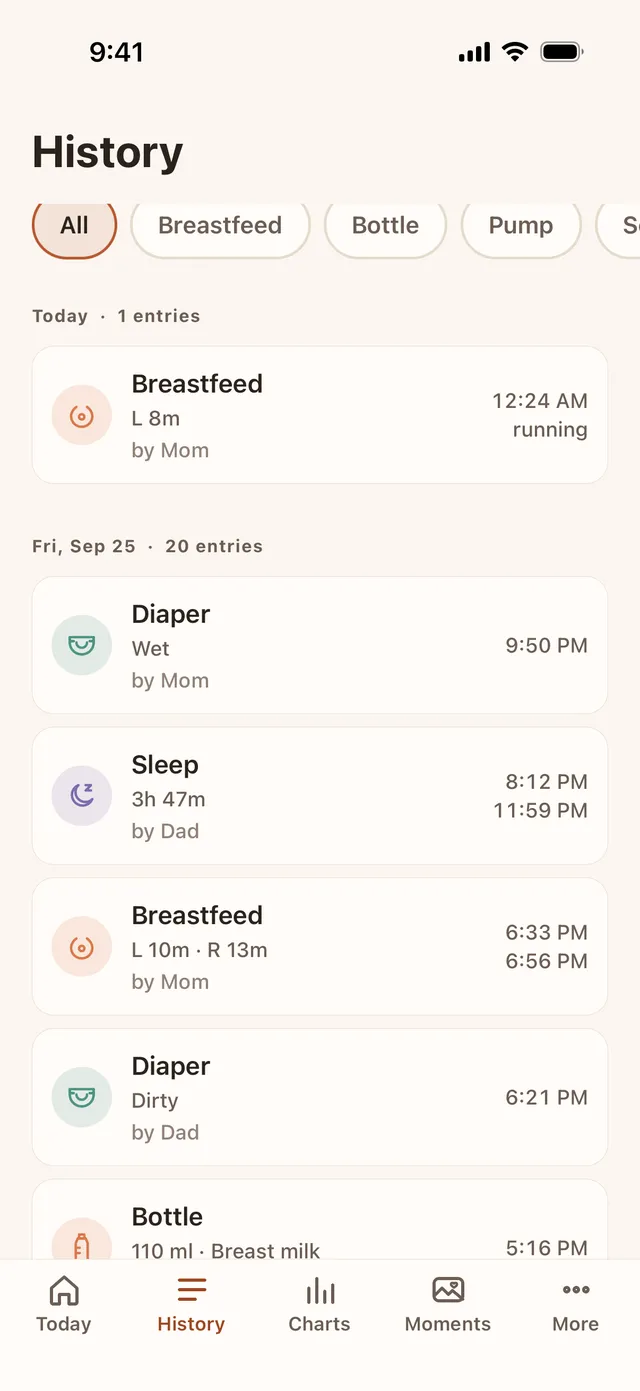
Log feeds from the Today screen, with a timer or by Siri, and both parents see the same log through their own iCloud. Every entry shows who logged it.
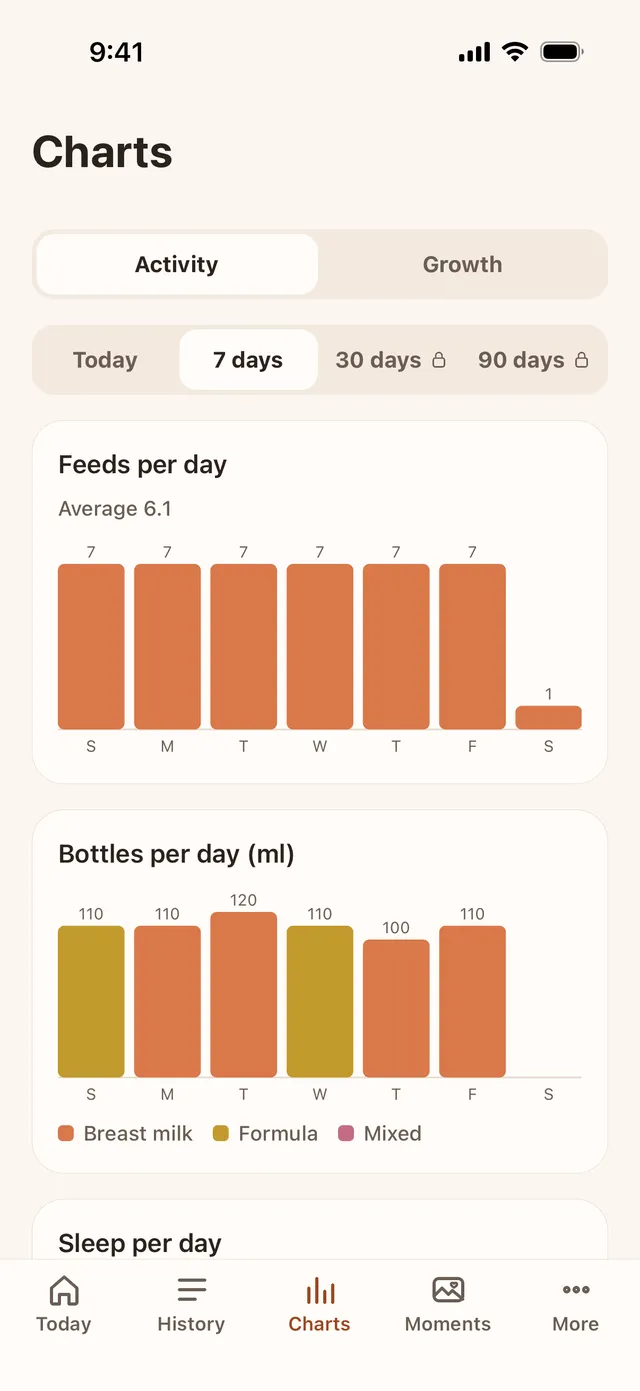
Charts draws feeds per day as bars with the average for the range, and sleep per day next to it. The 7-day view is free, and 30- and 90-day views are in Baton Plus. If this week's bars are clearly taller than last week's, you can see it at a glance. To compare against the week before, open the History list or export the CSV, which is free.
The Today screen also shows a morning summary with feeds, sleep and diapers compared with your baby's own 7-day average for the same hours, which is a quick way to see that a night was different. Baton does not tell you that your baby is having a growth spurt, and it does not say how often you should feed. It shows what you logged.
How do I read it?
Look at several days, not one night. A rise in feeds per day that lasts a few days and then falls back toward the earlier level matches the descriptions you will read. One busy evening does not.
Keep the diapers in view. Frequent feeding with the usual number of wet and dirty diapers is one picture; fewer wet diapers than before is another and a reason to call. Our guide on how many wet diapers a newborn should have explains what to count.
Call your midwife, health visitor or pediatrician if the extra feeding goes on for longer than a week or so, if your baby seems to feed poorly or cannot settle, if wet diapers drop, if there is a fever or your baby seems unwell, or if you are worried. Bring the log. In an emergency, call your local emergency number.
Frequently asked questions
- When do babies have growth spurts?
- KidsHealth says a breastfed baby's appetite often rises around 6 weeks and 3 months. Other sites quote more ages, but babies do not follow a calendar. Ask your pediatrician if you are unsure.
- How long does a growth spurt last?
- Most descriptions say a few days. If extra feeding goes on for much longer than a week, or your baby feeds poorly or has fewer wet diapers, call your pediatrician.
- Should I feed more often during a growth spurt?
- KidsHealth advises following your baby's hunger cues rather than the clock. Ask your midwife, health visitor or pediatrician what is right for your baby.
- Can Baton tell me my baby is having a growth spurt?
- No. Baton records what you enter and shows it in Charts and History. You compare this week with the last one yourself.