Daylight saving time and baby sleep: how to see what the clock change did with a simple log
Published 18 October 2026 · Đào Văn Thương · 5 min read
Twice a year in many countries the clocks move by an hour, and your baby has no idea. Babies run on hunger, tiredness and light, not on the wall clock, so the first mornings after the change can bring an early wake-up or a nap that suddenly feels an hour off. In 2026 the clocks go back on 25 October in the UK and EU and on 1 November in the US; other countries differ, so check yours.
This guide is about the part you can control without guessing: noting what really happens before and after the change, so you adjust to your own baby instead of to an article. It also explains what the change does to a log's numbers, including in Baton: Baby Tracker. It is general information, not medical advice: if you are worried about your baby's sleep, ask your pediatrician.
This guide is general information, not medical advice. Follow what your doctor, midwife or health visitor told you, and call emergency services in an emergency.
What does the clock change do to a baby?
Nothing happens to your baby at the moment the clock moves. What shifts is everything you do by the clock: the morning when you want them up, the nap you plan for noon, bedtime, and the light in the room. When the clocks go back, a baby who woke at 6:00 may now wake at what the clock calls 5:00, and that can feel like a very early start. Most families find things settle in the days that follow, but how fast differs from baby to baby.
Advice online ranges from “do nothing, it will sort itself out” to moving bedtime in 10 or 15 minute steps over several days. We did not find an official AAP or NHS rule for the clock change, so we do not give one here. If your baby has a hard time, or has a feeding or health condition that makes timing important, ask your pediatrician or health visitor what suits your baby.
Why a log beats guessing
After a clock change, parents often disagree about what happened: “she woke up so early” or “he barely napped”. With a log you can see it. Three numbers are enough:
- The time your baby woke up each morning.
- The time and length of each nap.
- The time they went down for the night, and how long the longest stretch was.
Write them down for the week before the change and the week after. If the morning wake-up moved by an hour for three days and then crept back, that is the baby adjusting. If nothing changed after a week, or sleep got a lot worse and stayed worse, take the notes to your pediatrician: they are far more useful than “she is sleeping badly”.
Make sure your phone has changed too
An iPhone changes its own clock if Settings, General, Date & Time, Set Automatically is on, which it is by default. If you turned it off, the times in your log, your alarms and your widgets will be an hour out until you change it back. Check it once, the day before.
If you keep a paper log, add a small note on the day of the change (“clocks back”). A single line saves you from wondering later why one night looks an hour longer.
Why one day has 23 or 25 hours
On the day the clocks go back, the day has 25 hours, and on the day they go forward it has 23. A night that crosses the change really is an hour longer or shorter than the clock times suggest. If you work out a night's length by subtracting the clock times in your head, you will be an hour off. Count real elapsed time, or let your app do it.
The same applies to daily totals. A day of 25 hours can legitimately hold an extra feed or a longer stretch awake, so do not read much into one odd total on that date. Compare weeks, not that single day.
How does Baton handle the change?
Baton stores every entry's time as an absolute moment (UTC), so a sleep that runs across the change keeps its real length. Day totals and charts are cut at local midnight, which means that on the change day they cover 23 or 25 real hours rather than a fixed 24. This is covered by the app's own tests for the 2026 US dates.
Everything that depends on the clock face follows your phone. A sleep that starts between 19:00 and 05:59 is counted as night sleep, and night mode starts at the time you set (20:00 to 07:00 unless you change it), so after the change they cover the new clock hours. If you want night mode to begin when it gets dark for your baby, change the times in the settings.
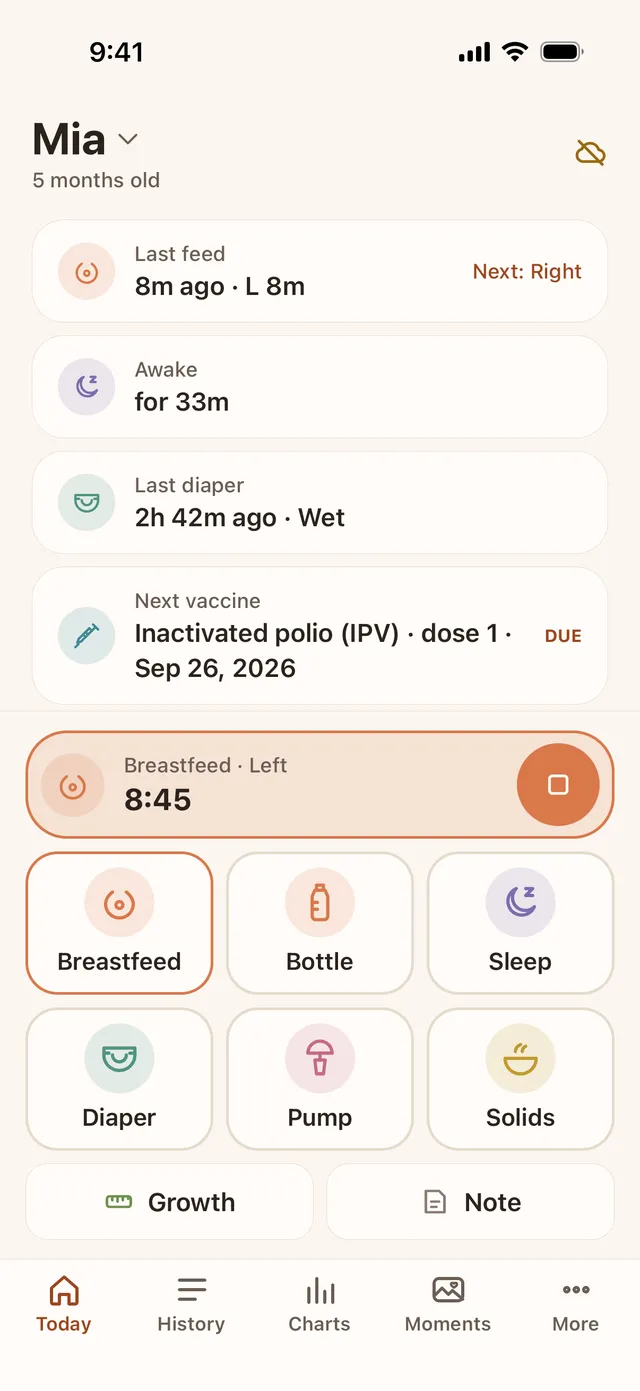
The free Today screen shows how long your baby has been awake since the last wake-up, which stays correct through the change because it counts elapsed time. A feed reminder (a Baton Plus feature) also counts hours from the last logged feed, not a time on the clock, so it keeps working the same way. Baton Plus's Next nap window is a suggestion from published age ranges, and the app does not adjust it for the change, so treat it as a rough guide for a few days and trust your baby's cues. Baton only records what you enter. It does not tell you what your baby's sleep should look like.
Safe sleep does not change with the clock
Whatever the time says, every sleep, including a nap that is an hour off, follows the same safe-sleep basics from the AAP: baby on their back, on a firm, flat surface, with nothing soft in the sleep space. If a baby is very hard to wake, or you are worried about their breathing, call your doctor or the emergency number rather than waiting to see what the log shows.
Frequently asked questions
- How long does a baby take to adjust to daylight saving time?
- It varies from baby to baby and we found no official figure. Many families see an early wake-up for some days and then things settle. A log of wake-ups and naps for the week before and after shows how your baby is doing. Ask your pediatrician if you are worried.
- When do the clocks change in 2026?
- In the UK and the EU the clocks go back on Sunday 25 October 2026, and in the US on Sunday 1 November 2026. Other countries use other dates, and many do not change the clocks at all.
- Does a baby tracker app adjust for daylight saving time?
- It should record real elapsed time. Baton stores each entry as an absolute moment, so a sleep across the change keeps its real length, and daily totals on that date cover 23 or 25 hours. Clock-based settings such as night mode follow your phone's clock.
- Should I move my baby's bedtime in small steps before the clock change?
- There is no official rule that we could find. Some parents shift by small steps and some do nothing. Ask your pediatrician what suits your baby, and use your log to see what works.
- Does Baton adjust the next nap window for the clock change?
- No. The Next nap window (Baton Plus) is a suggestion from published age ranges and your logged wake-ups, and does not treat the clock change specially. Use it as a rough guide and trust your baby's cues.