Baby wake windows by age: how long can your baby stay awake?
Published 13 October 2026 · Đào Văn Thương · 4 min read
A wake window is the time a baby is awake between one sleep and the next. Published tables give typical ranges by age: roughly 30 to 60 minutes for a newborn, growing to a few hours by the end of the first year. They are a rough guide to when a baby may be getting tired, not a schedule to obey.
This guide gives one of those tables, explains how to measure your own baby's wake window by writing down when they wake and when they fall asleep, and shows how Baton: Baby Tracker does the arithmetic. It is general information, not medical advice: if you are worried about your baby's sleep, ask your pediatrician.
This guide is general information, not medical advice. Follow what your doctor, midwife or health visitor told you, and call emergency services in an emergency.
What is a wake window?
It is the stretch from the moment your baby wakes up to the moment they fall asleep again, including feeding, a diaper change and play. Cleveland Clinic describes the idea as putting a baby down for a nap while they are sleepy but still awake.
Very young babies tire quickly, so the windows are short. They lengthen gradually as the baby grows. That is why a routine that worked at two months often stops working at five.
How long are wake windows by age?
Tables from different sources disagree by a few minutes, and none of them presents the numbers as more than guidelines. This is the table Baton uses, taken from Cleveland Clinic's “Wake Windows by Age” page. That page has no row for 4 to 5 months, so Baton applies the 3 to 4 month row to that month.
- 0–1 month: 30 to 60 minutes
- 1–3 months: 1 to 2 hours
- 3–5 months: 1 hour 15 minutes to 2 hours 30 minutes
- 5–7 months: 2 to 4 hours
- 7–10 months: 2 hours 30 minutes to 4 hours 30 minutes
- 10–12 months: 3 to 6 hours
Read the ranges as “typical”. A baby who is happily awake a little longer, or who needs to sleep a little sooner, is not doing anything wrong.
Should I follow wake windows or my baby's cues?
Use both, and let the baby win. A wake window tells you roughly when to start watching. Sleepy cues tell you what is actually happening: yawning, staring off, rubbing eyes, going quiet or getting fussy.
If your baby is overtired or fights sleep every time, that is useful information to write down and to mention at the next check-up. It does not mean you did something wrong.
Whatever the clock says, follow safe-sleep guidance for every sleep, including naps. The AAP's basics are to put the baby on their back on a firm, flat surface with nothing soft in the sleep space.
How do I find my own baby's wake window?
Your baby's own pattern is more useful than any table, and a week of notes is enough to see it.
- 1Each time the baby wakes up, note the time.
- 2Each time they fall asleep, note that time too. The gap between the two is one wake window.
- 3Mark which windows ended with easy sleep and which ended with a fight or a cranky baby.
- 4After several days, look at the easy ones. Their typical length is your baby's wake window for that time of day.
Windows are usually shorter in the morning and longer before bed, so compare the first nap with the first nap rather than averaging the whole day.
How do I track wake windows in Baton?
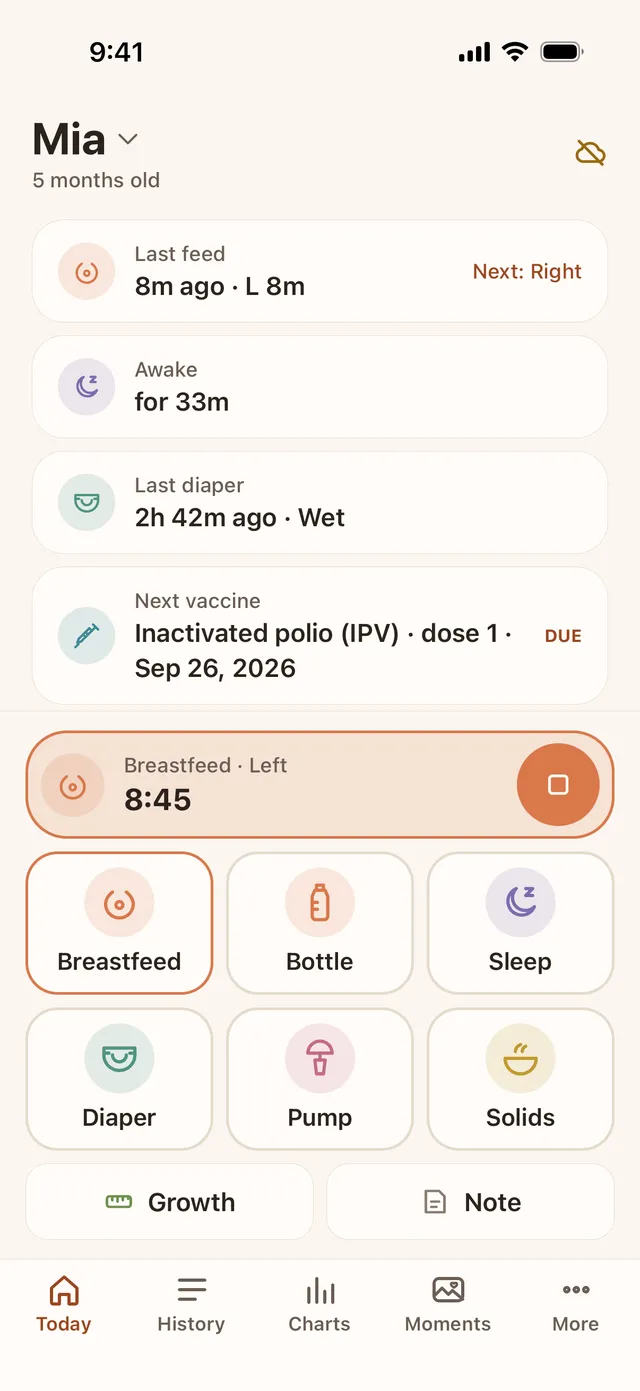
Tap Sleep when your baby falls asleep and tap it again when they wake. That is all the app needs. The Today screen then shows an Awake card with how long your baby has been awake, which is the number to compare with the table. This works in the free app.
A stretch of sleep that starts between 19:00 and 05:59 is treated as night sleep, and daytime sleeps count as naps. You can edit an entry afterwards if the guess is wrong.
Baton Plus adds a Next nap window card on Today. It takes your baby's age, finds the typical range in the table above, and adds it to the last wake-up time, so you see a range such as 10:40 to 11:10. After 7 days with sleep logged, the window narrows to a 30-minute range around your baby's own usual wake time before that nap, and it never leaves the table's range. Tap the card for “How is this calculated?”, which shows the formula and the source. Plus can also send a reminder 10 minutes before the window opens.
The table covers the first 12 months. After that the app offers no suggestion rather than making one up. It is a suggestion drawn from published ranges, not advice, and it cannot see how tired your baby actually looks.
When should I talk to the doctor about sleep?
Bring it up if your baby seems unusually hard to wake, sleeps far more or far less than you expected, or if you are worried about breathing or feeding around sleep. A log of wake-ups and sleeps over a week or two makes that conversation concrete. Baton records what you enter and does not interpret it.
Your pediatrician knows your baby's age, health and growth, and tables do not.
Frequently asked questions
- How long should a newborn be awake between sleeps?
- Published tables give about 30 to 60 minutes for babies under one month. It is a typical range, not a rule, so watch for sleepy cues and ask your pediatrician if you are unsure.
- How long is a wake window at 6 months?
- The table Baton uses, from Cleveland Clinic, gives 2 to 4 hours for 5 to 7 months. Other tables differ by some minutes, and every baby is different.
- Does Baton show how long my baby has been awake for free?
- Yes. Log sleep with the Sleep timer and the Today screen shows an Awake card with the time since the last wake-up. The Next nap window suggestion and its reminder are Baton Plus features.
- Is the next nap window medical advice?
- No. It is a suggestion from published age ranges, adjusted to your logs after 7 days. Mention sleep concerns to your pediatrician.
- What if my baby does not follow the table?
- That is normal. Trust your baby's cues and your own notes over the chart, and mention anything that worries you to your pediatrician.