Baby sleep regression: how to log it and tell it from a bad week
Published 21 October 2026 · Đào Văn Thương · 5 min read
A baby who slept well for weeks suddenly wakes every couple of hours, and the internet says it is “the 4-month sleep regression”. The name is popular with parents, but it is a label, not a diagnosis. What you can do is write down what is really happening, so you can see whether it is a pattern, how long it lasts and what you would want to tell your doctor.
This guide explains the term, what a public source says about it, and a simple log to keep for two weeks, on paper or in Baton: Baby Tracker. It is general information, not medical advice: if you are worried about your baby, ask your doctor or health visitor.
This guide is general information, not medical advice. Follow what your doctor, midwife or health visitor told you, and call emergency services in an emergency.
What is a sleep regression?
Parents use the phrase for a stretch when a baby who was sleeping reasonably well starts waking more at night, finds it harder to fall asleep or takes shorter naps. The Sleep Foundation describes the 4-month version as a time when a baby's sleep is going through a major change away from the newborn pattern, and notes that signs include more night wakings, trouble falling asleep and shorter naps. It also says that not every baby has one, and that some have trouble a few months earlier or later.
So treat it as a description of a common experience, not a calendar every baby follows. Other things also wake babies, such as illness, hunger, teething or a change in the room, which is one more reason a log is useful.
Is it a regression, or just a bad week?
One bad night means very little. A few nights in a row can be a cold, a growth spurt, a long day out or a warm room. A pattern needs numbers, and you do not need many of them. For about two weeks, write down:
- The time your baby fell asleep and woke for every sleep, night and day. The gaps between are the night wakings.
- How many times they woke between bedtime and morning, and which wakings needed a feed.
- The longest single sleep of the night.
- The length of each daytime nap.
- Anything unusual that day: a vaccination, a cold, new foods, a trip, a first tooth.
Look at the week before the trouble started and the week after. If the longest sleep got shorter and the night wakings went up on most days, that is a pattern worth knowing about. If it was two bad nights around a vaccination, it probably was just that.
How long does it last?
Parenting sites commonly say a few weeks, but they disagree and none of them can see your baby. Your own log is the better answer: after a week or two you can see whether the longest sleep is creeping back up. If it is not, or if your baby seems unwell, bring the log to your doctor or health visitor.
What should I do while it lasts?
That is a question for your doctor, health visitor or a trusted public source, not for this guide. What the log can do is stop you from changing five things at once. If you change the routine, the room or the feeding pattern on your doctor's advice, write down the date so you can see afterwards whether the numbers moved.
Whatever the night looks like, keep every sleep safe. The AAP's basics are the same on a good night and a bad one: on the back, on a firm, flat surface, with nothing soft in the sleep space.
How do I log it in Baton?
Tap Sleep when your baby falls asleep and tap it again when they wake. A full waking ends one sleep, and the next one starts when they go back down. If you forgot to start the timer, you can start it 5, 10, 15 or 30 minutes ago, and you can edit the times afterwards.
Every entry has an optional note, so you can write “cold”, “vaccine yesterday” or “first tooth” on the sleep it belongs to, and the note travels with the entry.
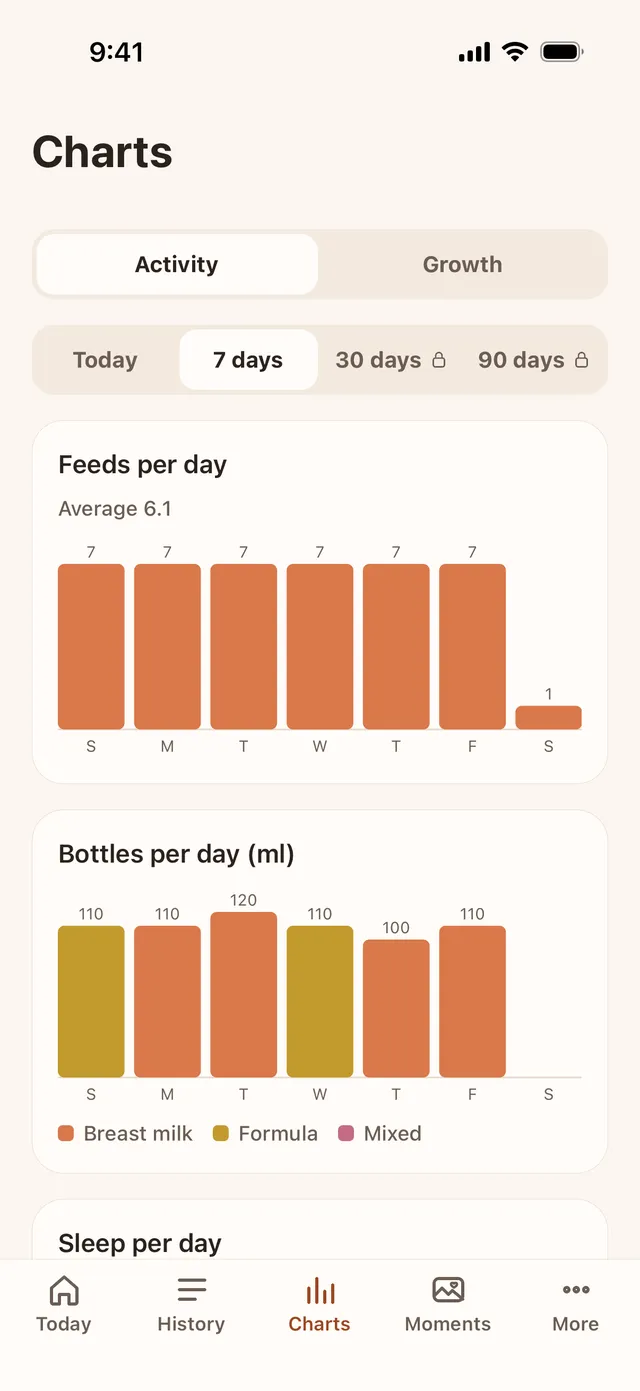
Open Charts. Today shows that day's total sleep split into naps and night, plus a Longest sleep tile. Baton counts a sleep as night sleep if it started between 19:00 and 05:59. The 7 days view shows sleep per day, night and day, for the last week, so two weeks of a regression fits in two looks, this week and last week. The 30- and 90-day trends are part of Baton Plus.
For the night in one number, open More and then Weekly summary: it shows this week's longest night next to last week's, as two plain numbers with no arrows or scores.
Baton only records what you enter. It does not decide that a night was bad or tell you what to do. If your partner or a grandparent also gets up at night, share the log so one person is not guessing at what the other wrote down, and so the number of wakings is not split across two notebooks.
When should I talk to the doctor?
Mention it if your baby seems unwell, has a fever, is feeding poorly, is unusually hard to wake, snores loudly or pauses breathing, or seems to be in pain, or if the broken sleep is wearing you down. Exhausted parents matter too. Bring the log: it turns “he is awake all night” into numbers a professional can work with. You can also export the log from Baton as a CSV file for free.
Frequently asked questions
- What is the 4-month sleep regression?
- It is a popular name for a period around 3 to 5 months when a baby's sleep changes and they may wake more, settle less easily or nap for shorter. It is not a medical diagnosis, and not every baby has one. The Sleep Foundation describes it as a major change away from the newborn sleep pattern. Ask your doctor if you are worried.
- How do I know if it is a sleep regression?
- Log sleep for about two weeks and compare the longest sleep and the number of night wakings with the week before. A drop that lasts for several days is a pattern. Rule out illness, teething and changes to the room, and ask your doctor if you are not sure.
- Can Baton show my baby's night wakings and naps?
- Yes. Log each sleep with the Sleep timer. Charts show total sleep split into naps and night, the 7 days view shows sleep per day, and Today shows a Longest sleep tile. All of this is free except the 30- and 90-day trends, which are part of Baton Plus.
- Does Baton tell me what to do about it?
- No. It records what you enter and shows it back, with no advice or score. For what to do, ask your doctor or health visitor.
- Can I add a note about a cold or a vaccine to a sleep?
- Yes. Every entry, sleep included, has an optional note, so you can write the reason next to the night.