When do babies drop to two naps? How to see it in your baby's sleep log
Published 26 October 2026 · Đào Văn Thương · 5 min read
“When do babies go from three naps to two?” is one of the most searched baby-sleep questions, and the honest answer is that no public health body gives a month. Parenting and sleep-coach sites quote ranges, but they disagree with each other, and every baby moves at their own pace.
What you can do is see it in your own baby's numbers. This guide explains why the number of naps falls over the first year, what to write down for a week or two, and how to read the log, on paper or in Baton: Baby Tracker. It is general information, not medical advice: if you are worried about your baby's sleep, ask your pediatrician or health visitor.
This guide is general information, not medical advice. Follow what your doctor, midwife or health visitor told you, and call emergency services in an emergency.
Why does a baby need fewer naps over time?
Two things change together. The American Academy of Sleep Medicine, with the AAP's endorsement, recommends 12 to 16 hours of sleep per 24 hours, including naps, for babies from 4 to 12 months. That total stays in the same range for months. Meanwhile the time a baby can comfortably stay awake grows. The wake-window table Baton uses, from Cleveland Clinic, gives 1 hour 15 minutes to 2 hours 30 minutes at 3 to 5 months, 2 to 4 hours at 5 to 7 months, 2 hours 30 minutes to 4 hours 30 minutes at 7 to 10 months and 3 to 6 hours at 10 to 12 months.
A day is only so long. As the stretches between sleeps get longer and night sleep consolidates, fewer naps fit into the daytime. That is all a “nap transition” is: the same sleep, in fewer and longer pieces. The tables are typical ranges, not rules, and other tables differ by a few minutes.
Is there a right age to drop a nap?
Not one that a public health source gives. If you read “6 months” on one site and “9 months” on another, both are summaries of what many families report, not a medical standard. Some babies keep a short last nap for a long time, and some drop it early, then come back to it for a week during a cold.
So use age as a rough background and your baby's own log as the evidence. The log is also what you would bring to your pediatrician if you want advice.
What should I write down?
For one to two weeks, so that one odd day does not mislead you, note for each day:
- How many naps there were, and the start time and length of each.
- The time your baby woke in the morning, and the time they fell asleep for the night.
- Which nap, if any, was refused, cut short, or needed a long time to start.
- Anything unusual: a vaccination, a cold, teething, a trip, a new daycare day.
Two times per sleep are enough: fell asleep and woke up. Everything else you can work out later.
What patterns do parents look for?
Sleep-coach sites often list the same signs, and a log lets you check them against facts instead of impressions:
- One nap is refused or skipped on most days of the week, not on one or two.
- The gap between the last nap and bedtime has grown, and bedtime has slid later.
- Naps are getting shorter while the baby is awake longer between them.
- Night sleep starts later or the morning waking is earlier than it used to be.
Two warnings. First, none of these proves the baby is ready; teething, illness, a growth spurt or a sleep regression can produce the same picture for a few days, and a log across a week or two helps you tell them apart. Second, a rough week is not a reason to change anything by itself. If you want to change the schedule, ask your pediatrician what is right for your baby.
How do I check it in Baton?
Tap Sleep when your baby falls asleep and tap it again when they wake. If you forget to press start, you can begin the timer 5, 10, 15 or 30 minutes ago, and every time can be edited afterwards.
To count the naps, open the History tab and tap the Sleep filter. It lists every sleep, grouped by day, with its start and end times, so the naps of one day are a short list you can count. Baton does not show a nap count as a number, and the Sleep per day chart shows total minutes, so count the sleeps in History.
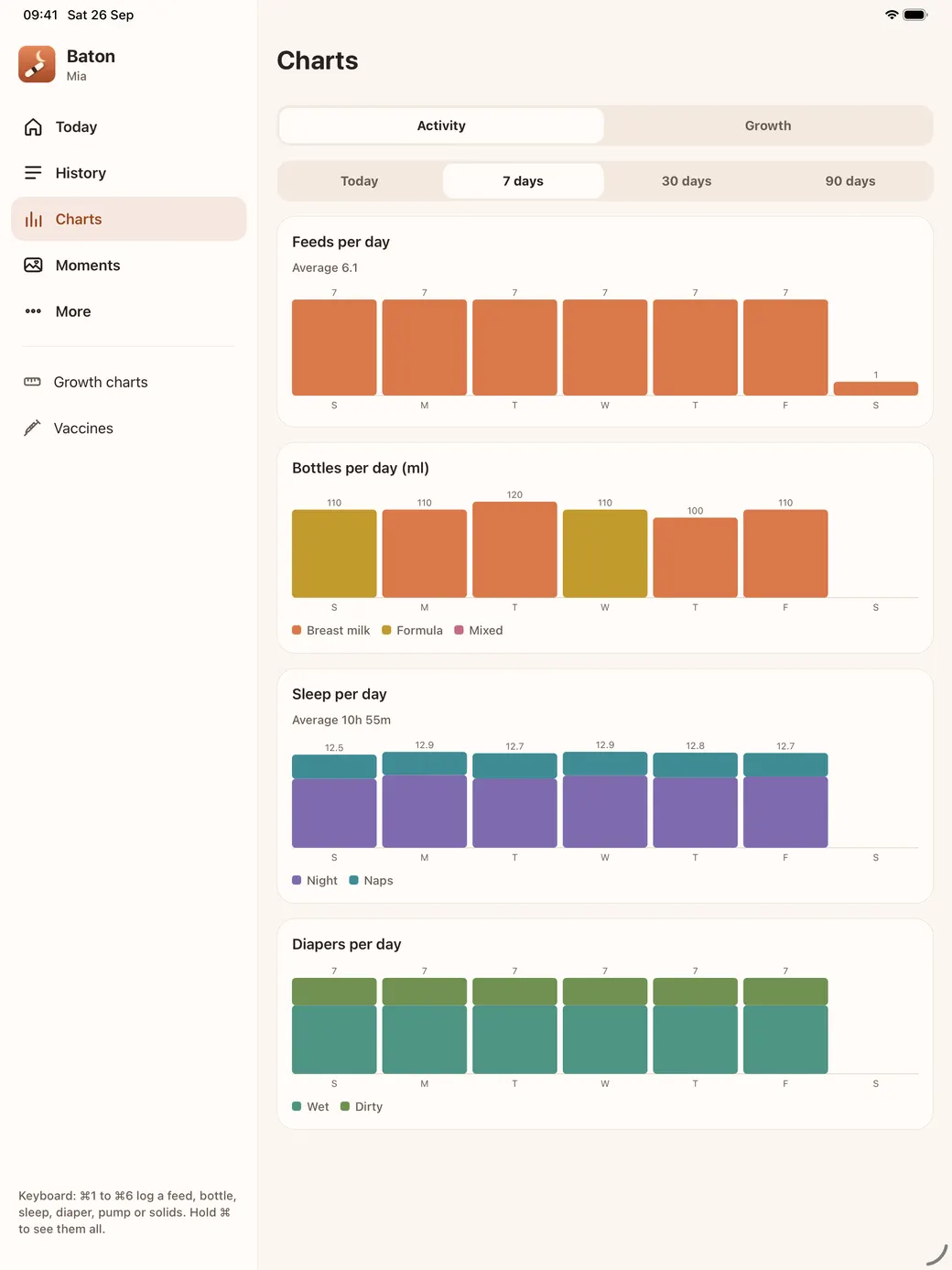
In Charts, Today shows a timeline strip with the day's sleep blocks, and a Sleep card that adds up the time into naps and night, next to a Longest sleep tile. The 7 days view shows sleep per day as night and nap bars. Baton counts a sleep as night if it starts between 19:00 and 05:59 and as a nap otherwise, so a sleep that begins at 18:30 is counted as a nap. The 7 days view is free; 30- and 90-day trends are part of Baton Plus.
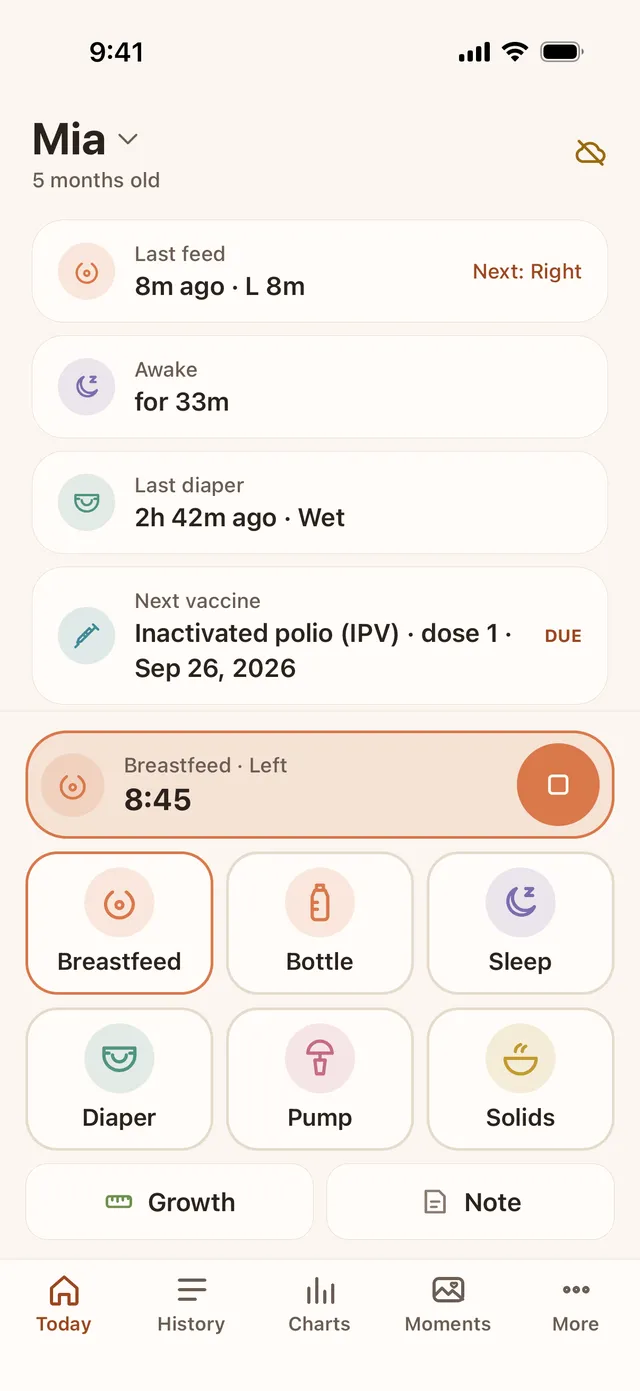
The Today screen has an Awake card with how long your baby has been awake, which is the number to compare with the table. Baton Plus adds a Next nap window card that uses the same table, narrowed to your baby's own pattern after 7 days of logged sleep; it covers the first 12 months only. It is a suggestion from published ranges, not advice. If your partner uses Baton through their own iCloud account, they see the same sleeps, and CSV export of every entry is free if you want to put the numbers in a spreadsheet.
Whatever the number of naps, keep every sleep safe
The AAP's safe-sleep basics apply to every nap, in every schedule: baby on their back, on a firm, flat surface made for babies, with nothing soft in the sleep space. A baby who falls asleep in a car seat, stroller or swing for part of a nap is not on a flat surface, so move them to a safe sleep space once you can.
When should I ask the doctor?
Ask your pediatrician or health visitor if your baby seems unusually hard to wake, is feeding poorly, sleeps much less or more than you expected, has a fever, or if anything about their sleep worries you. You do not need a log to justify a call. When you do go, a week or two of sleep times turns “the naps are a mess” into something specific. In an emergency, call your local emergency number.
Frequently asked questions
- When do babies drop to two naps?
- No public health body gives an exact age. Parenting sites quote ranges that differ, and babies move at their own pace. A week or two of logged sleep times shows what your own baby is doing, and your pediatrician can advise.
- How do I know my baby is ready to drop a nap?
- Common signs are a nap refused on most days, shorter naps, a later bedtime or earlier waking. Illness, teething and a growth spurt can look the same for a few days, so look at a week or two of times and ask your pediatrician before changing the schedule.
- How much should a baby sleep in a day at 6 to 12 months?
- The American Academy of Sleep Medicine recommends 12 to 16 hours per 24 hours, including naps, for babies from 4 to 12 months, a range the AAP has endorsed. Individual babies vary, so ask your pediatrician if you are unsure.
- Can Baton count my baby's naps?
- Baton shows total nap time and night sleep per day in Charts, and the History tab lists each sleep with its start and end, so you can count them. It does not show a nap count as a single number.
- Does Baton tell me when to drop a nap?
- No. It records what you enter. Baton Plus suggests a next nap window from published wake-window ranges for the first 12 months, which is a suggestion, not advice.